
Reading is So Awesome
I am so excited to start my summer reading tutoring this week! This tutoring experience will be a great way for me to practice reading intervention lesson and strategies I can use for years to come!
I feel like the beginning of tutoring has to be the trickiest part. From my undergrad experiences in tutoring for my reading instruction courses, the first couple of sessions are filled with uncertainty as you try to get to know your student and administer assessments to get a feel for where they are academically. If you can get off to a good start and keep organized at the beginning, the rest of tutoring can be a time for productive instruction and targeted intervention.
Take a look at some of the organization strategies and opening activities I am using for tutoring this summer:
Tutoring Binder
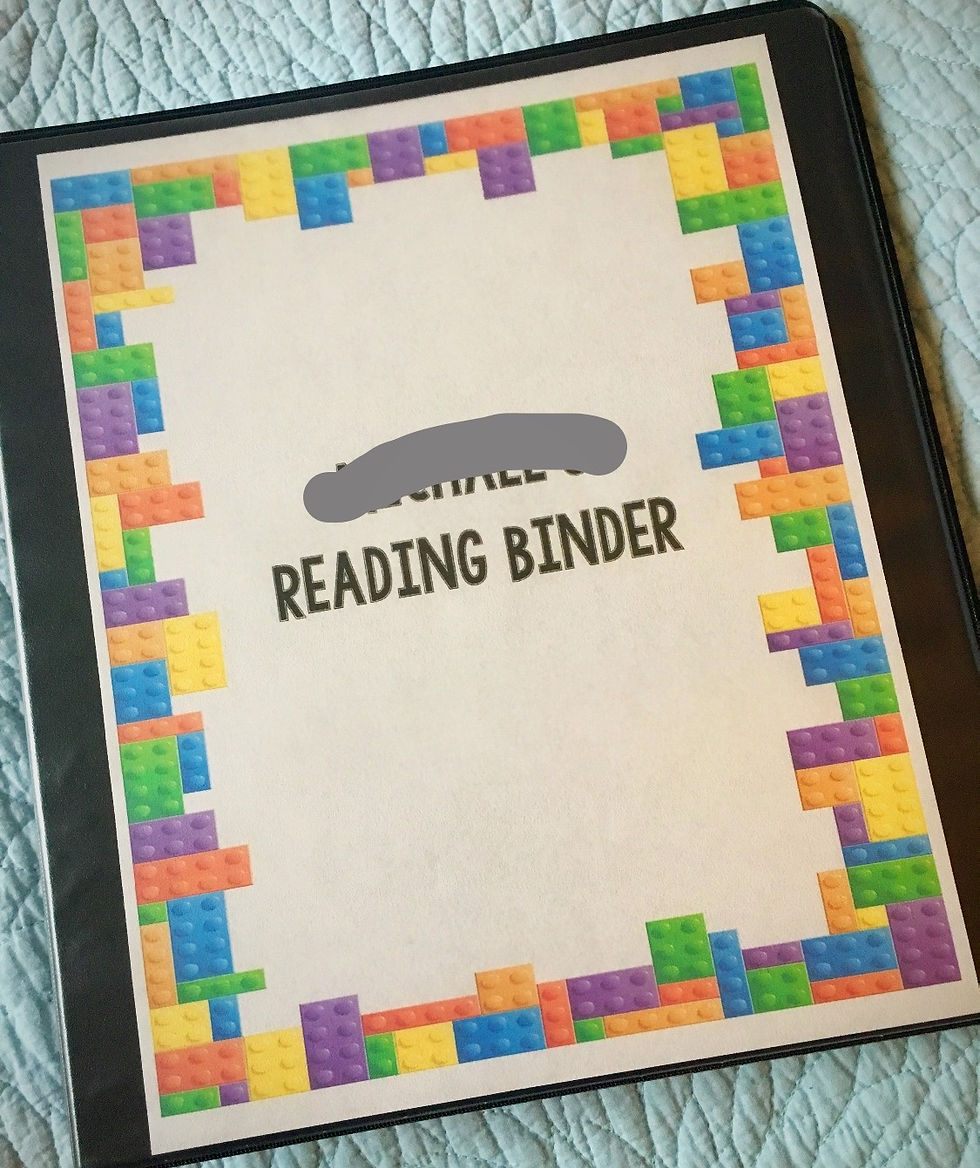
(My student likes legos if you can't tell :P)
This tutoring binder is the main method I am going to use to stay organized. Using a binder allows me to keep all of my tutoring materials in one place and will keep it easily accessible during sessions. In addition, since I am only tutoring one student this summer one binder was not a huge expense and will be great to let my student take home at the end of our time together to remember everything we have worked on together. A cheaper alternative to a binder would be to send the materials home in a pronged folder at the end of the session. I have also had experience with using an interactive reader's notebook (composition book) for pull out tutoring. This would be a great option to use with an entire class to store in your room throughout the school year. The students can update their notebooks over the course of the year with their work, readings, writing, and even comprehension strategies and tools. Click HERE to see some of the pages in my interactive reader's notebook from a previous tutoring session.
Inside the binder I have some resources in the left side pocket and my table of contents. Pockets are a HUGE benefit of binders because it allows you to store some of the materials you'll need for your next session close by. The table of contents tabs are from Office Depot. This summer I will have 12 sessions with my student so these tabs work perfectly! There are plenty of other table of contents table styles at Office Depot and on Amazon. Using the table of contents allows me to sort my tutoring materials by session and keep track of what we have already completed. I can't wait to see the list completely filled, but for now I just have the first session under my belt.
Pre-testing Packet
To begin my tutoring sessions I need to administer a handful of pretests in order to evaluate my student's read and writing level. The pre-tests I will use come from my CTRD 7400 graduate level course materials and from the Qualitative Reading Inventory 5. In order to make these tests easier to administer I have printed them out and stapled them to create an "assessment packet." There are plenty of different assessments that can be used to measure reading and writing ability, but here are the main areas that need I will be assessing:
Phoneme Identities
Letter Recognition
Psuedoword Reading Test
QRI Sight Vocabulary Word Lists
Invented Spelling
Auditory Blending
Missing Vowel Correspondences
QRI Passage Reading Levels (Independent, Instructional, and Frustration)
What are some of your favorite reading assessments you use at the beginning of tutoring or the school year?
All About Me Jar
As fun as assessments are, I am sure your student would prefer some fun activities for the first day of tutoring. In order to break up the assessments we used an All About Me Jar. I took a Primary Grade Interest Inventory and cut the questions into strips, folded them, and dropped them into a small mason jar. Between each Pre-test assessment I let my student draw an About Me question from the jar and he got to answer it. Not only did this tell me a little bit more about my student, but it was more fun for him than just listening to me read or ask him questions. HE got to be the one to randomly pick them!
All About Me Jar Interest Inventory Questions
Tutoring Cubby
Last, but certainly not least, is the tutoring cubby. I'm not going to lie, I can't take credit for the idea of using a tutoring cubby at all. In fact, because I am tutoring through an on campus program in a room with many other tutors, creating a cubby was required. Not only does it provide a little privacy to help the student focus, but it can also create a fun atmosphere to work in. I decorated the cubby based on my student's interests.

As you can see, I turned my tutoring cubby into a LEGO city! My student loves everything to do with LEGOs! I asked him which LEGO set was his favorite and he said I basically like every single one. The idea is for there to be something on the board the student can interact with as we move through the four phases of our session. After each activity my student will be able to select a "character" for that day and move him from the house building on the left to work at the police station on the right, since my student also said he wanted to be a police officer when he grows up. In addition, these characters will be excellent props for creative writing prompts since we end each session by writing a message.
Our tutoring rules are on the right side:
Follow directions
Stay behind the cubby
Always do you best
That's my tutoring "start up kit." I would love to hear some of your ideas as well! What do you like to do to make the tutoring session more fun for your student? How do you keep organized?
And in case it wasn't stuck in your head already....
Everything is AWESOME! (especially reading!)


Comments